
How to get rid of mould in a car
To get rid of mould in a car, dry it out completely, remove the source of the damp, vacuum loose spores, and clean every affected surface. Light surface mould on hard trim can often be cleaned at home. If it's in the carpet underlay, seat foam or headliner, or keeps coming back, it needs professional removal.

Luis Lima, founder. We remove mould from cars at our Alexandria workshop with ozone treatment and by taking the interior apart. Here's what you can safely try first.
| What you're seeing | Home clean? | Call a pro? |
|---|---|---|
| Light spots on hard plastic trim | Usually yes | If it comes back |
| Mould on seat fabric or leather | Sometimes | If it's spread |
| Damp or musty carpet | Not really | Yes, the underlay holds water |
| Mould on the headliner | Risky | Yes |
| Smell returns after cleaning | No | Yes, the source is still there |
Why does mould grow inside a car?
Mould needs damp, warmth and somewhere dark to settle. A leaking seal, a window left down in a storm, or a wet towel forgotten in the footwell gives it all three.
A closed car on a warm Sydney day is, unfortunately, a five-star resort for mould. It checks in. Then it invites its friends.
- Leaking door or window seals
- Windows or sunroof left open in rain
- Wet gear, towels or wetsuits left inside
- Spilt drinks soaked into carpet
- Blocked drains under the windscreen
How to remove mould from a car yourself
Work in a well-ventilated space, and wear gloves and a mask, because disturbing mould sends spores into the air. Park in the sun with the doors open so everything can dry.
Vacuum loose mould with a vacuum that has a HEPA filter, so you're not just blowing spores around. Clean hard surfaces with a cleaner made for car interiors, then dry everything thoroughly.
Most importantly, find and fix where the water got in. Otherwise you're just cleaning the stage for the sequel.
- Ventilate: doors open, in the sun if you can
- Gloves and a mask on
- Vacuum loose spores with a HEPA-filter vacuum
- Clean hard surfaces with an interior-safe cleaner
- Dry everything completely
- Find and fix where the water got in
Mould on car seats
Light mould on leather can usually be wiped off with a leather-safe cleaner, followed by a conditioner. Fabric seats are harder, because the mould gets into the foam underneath.
If you can still smell it after the seat's dry, it's living deeper than a wipe can reach.
When to get it professionally removed
If the carpet's been wet, the underlay probably still is. That's where mould loves to hide, and you can't dry it properly without lifting things out.
The same goes for headliners and seat foam. And if the smell comes back a week after you've cleaned, the source is still there.
How we do it
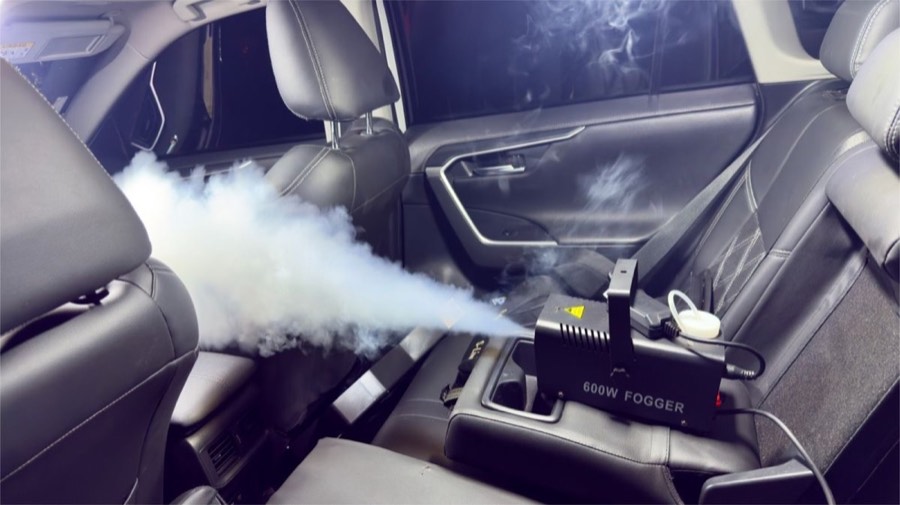
We take the interior apart to reach where the mould is actually living, clean everything, then run an ozone machine through the cabin. It's gone, not masked with a pine tree.
Hannah W.'s car had "developed mould after water damage from the rain", and she dropped it off at the workshop. Removal starts from $499 ex GST.
Questions
Is mould in a car dangerous?
Mould can irritate some people, especially anyone with allergies or asthma, so it's worth dealing with quickly and cleaning carefully with gloves and a mask.
Will vinegar kill mould in a car?
It can help on hard surfaces, but it won't reach mould inside carpet underlay or seat foam, which is where it usually comes back from.
How much does car mould removal cost?
At Gil's it starts from $499 ex GST, done at our Alexandria workshop.
How do I stop mould coming back?
Fix the leak or source of damp, keep the interior dry, and don't leave wet items inside. Once the source is gone, mould has nothing to come back to.
If it's beyond a home clean, see how we remove it properly on our car mould and odour removal page, or call 0483 964 880.